What are conductive plastics?
The electrical properties of a plastic are often described by its electrical resistance. Depending on the resistance range, they are classified as antistatic, dissipative (ESD), or electrically conductive materials. While antistatic plastics reduce the buildup of electrostatic charges, ESD plastics ensure their controlled dissipation. Electrically conductive plastics have a significantly lower resistance and can transmit electrical currents or contribute to electromagnetic shielding.
Since standard plastics do not contain freely moving charge carriers, they generally act as electrical insulators. Electrical conductivity is therefore only achieved through targeted modification of the material. Two fundamental approaches have become established for this.
In intrinsically conductive polymers, conductivity is based on the chemical structure of the material itself. These materials are primarily used in specialized applications. In industrial practice, however, compounded plastics dominate. In this process, conductive additives are incorporated either as particles (conductive carbon black, carbon fibers, carbon nanotubes, metal) or as a liquid organopolymer medium. Once their proportion exceeds a certain threshold, a continuous conductive or antistatic network is formed within the material.
In this way, the typical advantages of plastics—such as low weight, corrosion resistance, and high design freedom—can be combined with defined electrical properties. This makes conductive plastics suitable for numerous applications in electronics, automation, and conveyor technology.
The three levels of conductivity: antistatic, dissipative, conductive
Electrically conductive plastics are categorized into different conductivity classes based on their electrical surface resistance. This classification is important because different applications have different requirements for handling electrical charges. While in some cases the goal is simply to prevent electrostatic charging, other applications require controlled dissipation or even active current conduction.
Insulating plastics typically have a surface resistance of approximately 10⁹ to 10¹² Ω. They reduce the buildup of electrostatic charges on component surfaces and prevent the uncontrolled accumulation of electrical charges. Typical areas of application include packaging, housings, or conveyor components.
Antistatic plastics / ESD plastics have a surface resistance of approximately 10⁷ to 10⁹ Ω . They enable a controlled and slow dissipation of electrostatic charges, thereby protecting sensitive electronic components from damage caused by electrostatic discharge (ESD). These materials are frequently found in electronics manufacturing, automation technology, or semiconductor production.
Electrically conductive plastics have a surface resistance of less than 10⁴ Ω. In this class, electrical currents can be transmitted in a targeted manner or electromagnetic interference can be shielded. Such materials are used, for example, for EMC applications, sensor technology, or special technical components.
Overview of conductivity classes
When selecting materials, it is not enough to simply ask whether a plastic is conductive. The decisive factor is which resistance range is required for the specific application. Even within the ESD class, requirements can vary significantly depending on the component, environment, and protection concept. Therefore, in practice, conductive plastics are designed on an application-specific basis.

Electrically vs. thermally conductive plastics
Electrically conductive and thermally conductive plastics serve different purposes and are often confused with one another. While electrically conductive plastics enable the transport or dissipation of electrical charges, thermally conductive plastics are used to dissipate heat in a targeted manner and reduce temperature spikes.
Electrical conductivity is typically achieved through additives such as conductive carbon black, carbon nanotubes (CNT), carbon fibers, or metal fibers. Such materials are used, for example, in ESD applications, electronics manufacturing, EMC shielding, or in electrically functional components.
Thermally conductive plastics, on the other hand, are equipped with special heat-conducting fillers, such as boron nitride, aluminum oxide, or graphite. The goal here is not electrical conduction, but the most efficient heat transfer possible within the component. This helps protect electronic components from overheating and increases the service life of devices.
In some applications, both properties are combined. However, most materials are specifically optimized for either electrical conductivity or thermal conductivity. Therefore, it must be clearly defined during the development phase whether electrical charges need to be dissipated or heat needs to be transported efficiently. Only then can the appropriate material solution be selected for the respective application.
Applications of conductive plastics
Conductive plastics are used wherever electrical charges must be dissipated in a controlled manner, electromagnetic interference must be reduced, or electronic functions must be integrated into components. Requirements range from simple ESD protection to highly specialized applications in electronics and automation technology.
Applications can be found in sensor technology, MID (Molded Interconnect Devices) components, and parts that capture or transmit electrical signals.
Dissipative materials also play an important role in conveyor and handling technology. In ESD-protected production areas, electrical charges often need to be dissipated in a controlled manner via ground contact. For this purpose, dissipative rollers, wheels, and other moving components are used, which must withstand high mechanical loads in addition to providing defined electrical properties.
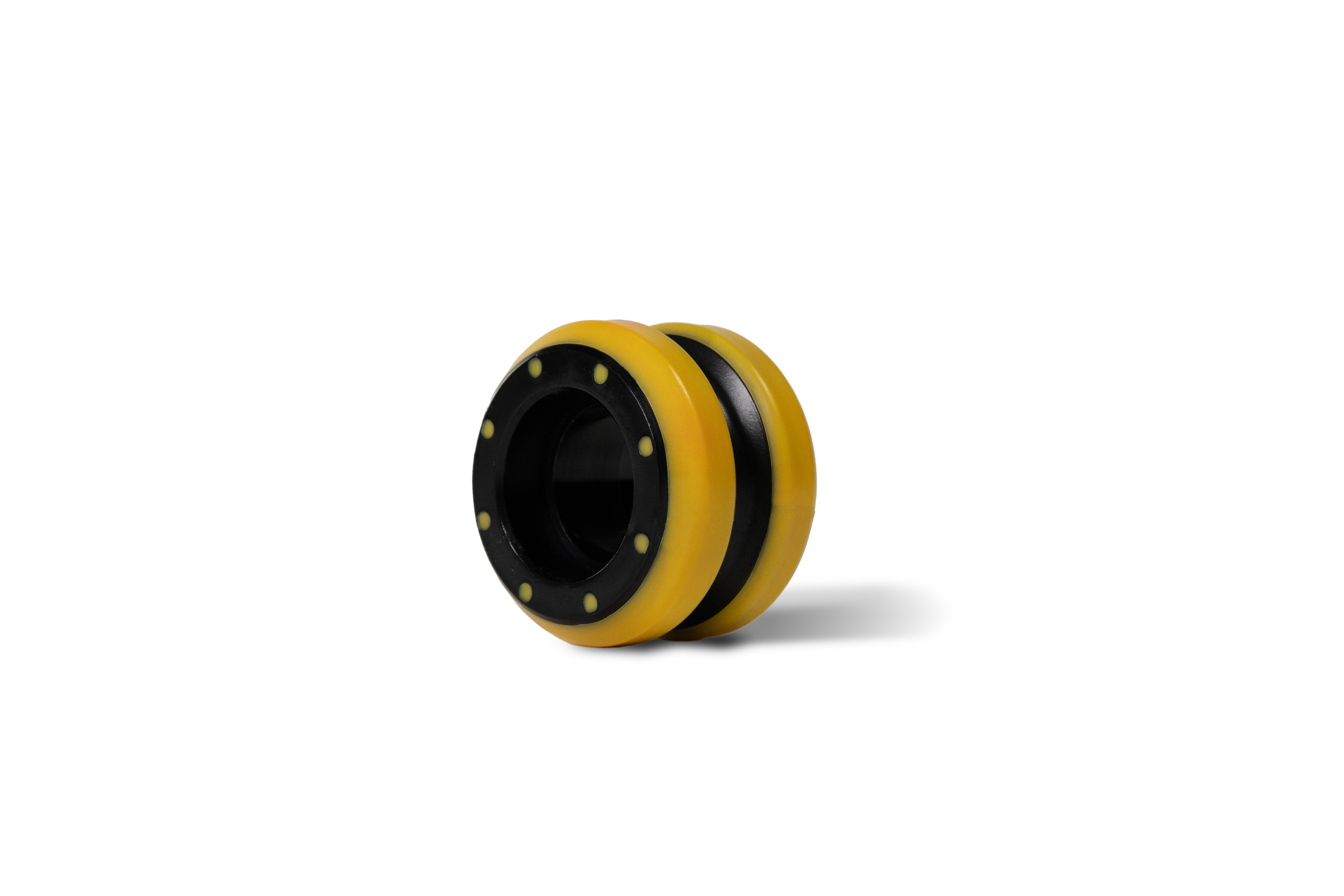
At INTERNORM, we develop and manufacture dissipative and antistatic rollers and wheels made of polyurethane, customized to meet individual customer requirements. Depending on the area of application, load, environmental conditions, and required resistance range, the material solution is specifically engineered. This results in tailor-made components that reliably dissipate electrostatic charges while simultaneously meeting high demands for wear resistance, load-bearing capacity, and service life.
Non-conductive & insulating plastics – the distinction
While conductive plastics can specifically dissipate or transmit electrical charges, many standard plastics are intentionally designed as electrical insulators. Their high electrical resistance prevents current flow and protects components, systems, and users from unwanted electrical voltages.
Some of the best-known electrically insulating plastics include polyurethane (PUR), polyethylene (PE), polypropylene (PP), polyvinyl chloride (PVC), and polytetrafluoroethylene (PTFE). These materials naturally possess very low electrical conductivity and are therefore used in numerous electrotechnical applications.
Electrical insulation is particularly desirable where current must be safely routed or separated from adjacent components. Typical examples include cable insulation, connectors, electronic device housings, control cabinets, or insulating components in electrical systems. Here, the focus is not on the controlled dissipation of charges, but on reliable protection against current flow and short circuits.
Whether a conductive or insulating plastic is the right choice always depends on the specific application. While defined electrical properties are required in ESD areas or electronic manufacturing processes, insulating plastics form the basis for safe and reliable operation in many electrotechnical applications.
Conductive plastics at a glance
Conductive plastics bridge the gap between electrically insulating plastics and metallic materials. Depending on the requirements, antistatic, dissipative (ESD), or electrically conductive materials are used.
Which material solution is best suited depends on the required resistance range, mechanical requirements, and operating conditions. In addition to electrical function, factors such as wear resistance, load-bearing capacity, environmental conditions, and processability often play a decisive role.
Especially for components with defined requirements for conductivity, it is advisable to coordinate the material, geometry, and operating conditions at an early stage. This allows electrical and mechanical properties to be optimally matched to one another and ensures the desired function in the long term.

FAQ
Here you will find direct answers to frequently asked questions.
What are some examples of conductive plastics?

Intrinsically conductive plastics include PEDOT:PSS, polyaniline, polypyrrole, and polyacetylene. More common are compounded plastics such as PA, PC, or PP with conductive carbon black, carbon nanotubes, or carbon fibers, which are specifically adjusted to be antistatic or conductive.
What is an example of a conductive plastic?
A well-known example is PEDOT:PSS, an intrinsically conductive polymer used in displays and antistatic coatings. More common in everyday industrial use are carbon-black-filled plastics for ESD applications.
Which plastic is dissipative?
Dissipative plastics have a surface resistance of approximately 10⁷ to 10⁹ Ω – usually PA, POM, PC, or PP with conductive carbon black. They dissipate static charge in a controlled manner and are used in ESD protection.
Which plastics are electrically insulating?
Most standard plastics such as polyethylene (PE), polypropylene (PP), PVC, and PTFE are excellent electrical insulators. They are used where current should specifically not be conducted, such as in cable insulation and housings.